

The main types of bariatric surgery

There is no single “best” weight-loss operation for everyone. Each procedure works differently and has its own benefits, risks and lifelong requirements. Your surgeon will consider your health history, reflux, weight, eating patterns, medications, previous
operations and personal goals.


Simplified educational diagram: Sleeve gastrectomy (gastric sleeve surgery). Not to surgical scale. Clinical review required before publication.
Sleeve Gastrectomy (Gastric Sleeve Surgery)

What happens?
The surgeon removes approximately 75–80% of the stomach, leaving a narrow, sleeve-shaped stomach.

How does it work?
The smaller stomach holds less food. The operation also changes hormonal signals involved in hunger, appetite and fullness.

What should I know?
Gastric sleeve surgery is the most commonly performed bariatric procedure. It does not reroute the intestine and is generally less complex than gastric bypass. Lifelong supplements and blood tests are still required. Because sleeve gastrectomy may cause new or worsening reflux, tell your surgeon about any history of heartburn, reflux or previous stomach surgery.
Roux-en-Y Gastric
Bypass Surgery
What happens?
The surgeon creates a small pouch from the upper stomach and connects it to the small intestine. Food bypasses most of the stomach and the first section of the small bowel.
How does it work?
The small pouch limits meal size. Intestinal rerouting also changes absorption and gut hormones involved in appetite and blood-sugar control.
What should I know?
Roux-en-Y gastric bypass generally produces somewhat greater average weight loss than sleeve gastrectomy and can be particularly effective for type 2 diabetes and significant reflux. It is a more complex operation and requires lifelong supplements, regular blood tests and careful follow-up.

Simplified educational diagram: Roux-en-Y gastric bypass surgery. Not to surgical scale. Clinical review required before publication.
.png)
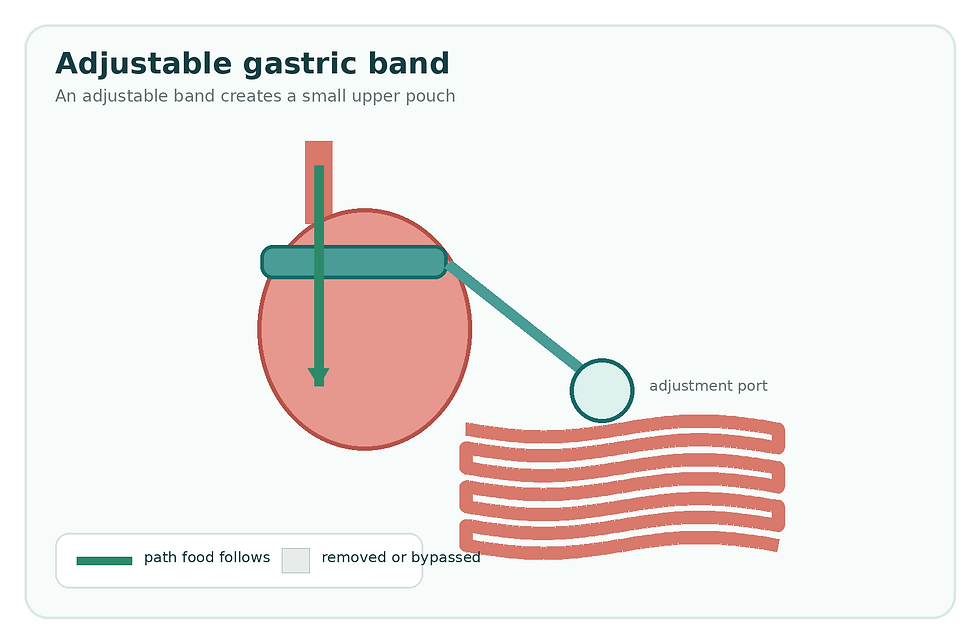
Simplified educational diagram: Adjustable gastric banding (Lap-Band). Not to surgical scale. Clinical review required before publication.
Adjustable Gastric Banding (Lap-Band)
What happens?
An adjustable band is placed around the upper stomach, creating a small pouch. The band is connected to a port beneath the skin.
How does it work?
The band limits how much food can comfortably pass into the stomach at one time. It does not remove the stomach or reroute the intestine.
What should I know?
Gastric band surgery is now performed much less often worldwide. It generally produces less weight loss than sleeve or bypass surgery and requires regular adjustments. Over time, some patients need band removal or conversion to another operation because of complications, intolerance or insufficient weight loss.
One anastomosis Gastric Bypass (OAGB or Mini Gastric Bypass)
What happens?
The surgeon creates a long, narrow stomach pouch and connects it to the small intestine using one surgical join.
How does it work?
OAGB combines a smaller stomach capacity with intestinal bypass, affecting food intake, absorption and appetite-related hormones.
What should I know?
OAGB can produce significant weight loss and metabolic improvement, but it is not offered by every surgeon or bariatric centre. Lifelong supplementation and nutritional monitoring are essential. Your surgeon can explain risks such as bile reflux and whether OAGB suits your health history.
.png)
Simplified educational diagram: Adjustable gastric banding (Lap-Band). Not to surgical scale. Clinical review required before publication.
.png)
Simplified educational diagram: Biliopancreatic diversion with duodenal switch (BPD/DS). Not to surgical scale. Clinical review required before publication.
Biliopancreatic diversion with duodenal switch (BPD/DS)
What happens?
This operation combines a sleeve gastrectomy with extensive rerouting of the small intestine.
How does it work?
The sleeve reduces stomach capacity, while the intestinal component substantially reduces calorie and nutrient absorption.
What should I know?
Duodenal switch surgery generally produces the greatest average weight loss of the procedures in this guide, but it also carries the greatest risk of nutritional and protein deficiencies. It is used selectively and requires an especially strong commitment to lifelong supplements, blood tests and specialist follow-up.
Bariatric surgery comparison
This comparison is a general guide rather than a prediction of your result.
“Relative” descriptions compare the procedures with one another; individual outcomes vary.
Procedure | Intestinal rerouting | Relative weight-loss potential | Nutritional follow-up |
|---|---|---|---|
Duodenal switch | Yes—extensive | Very high | Lifelong; more intensive |
OAGB | Yes—one join | High to very high | Lifelong; more intensive |
Gastric band | No | Lower | Ongoing band and nutrition review |
Roux-en-Y Bypass | Yes—two joins | High to very high | Lifelong; more intensive |
Gastric Sleeve | No | High | Lifelong |
What can I expect after bariatric surgery?

Weight-loss results and long-term health
Most weight loss occurs during the first 12–18 months after surgery, although the rate and amount differ from person to person.
Some weight regain in later years is common and does not automatically mean that you—or your operation—have failed.
Weight is influenced by biological, medical, emotional and lifestyle factors, which is why ongoing care and early support matter.
Bariatric surgery may also improve type 2 diabetes, high blood pressure, cholesterol, obstructive sleep apnoea, fatty liver disease, joint pain,
mobility, fertility and quality of life. Results vary according to the operation, your starting health and how long you have lived
with a condition. Continue prescribed medication unless your treating doctor advises otherwise.

How do I choose the right weight-loss procedure?
The most appropriate operation depends on your BMI, overall health, obesity-related conditions, history of reflux, previous surgery, medications, lifestyle, personal preferences, goals and ability to commit to supplementation and follow-up. You do not need to choose before meeting a surgeon. A bariatric consultation exists to assess your health, explain suitable options and answer your questions.
Questions to ask your bariatric surgeon
→ Which treatment options—including medication, endoscopic treatment and surgery—may suit me, and why?
→ Which bariatric procedure do you recommend for me, and why?
→ How many times have you performed this procedure?
→ What are your complication and revision rates?
→ What risks apply to my health history?
→ What weight-loss result may be realistic for me?
→ How could treatment affect my health conditions and current medications?
→ What will I eat during recovery and in the longer term?
→ Which supplements and blood tests will I need?
→ What support is available if I struggle or regain weight?
→ How may treatment affect a future pregnancy?
→ What are the total costs, including follow-up, medication, procedures and supplements?
→ What insurance, public funding or financing pathways may be available where I live?